

You may have already encountered this notification while browsing the internet: “Not Secure Site.” But did you know that there is a simple and effective solution to make your website completely secure? By switching from HTTP to HTTPS, you can offer your users a 100% secure browsing experience.
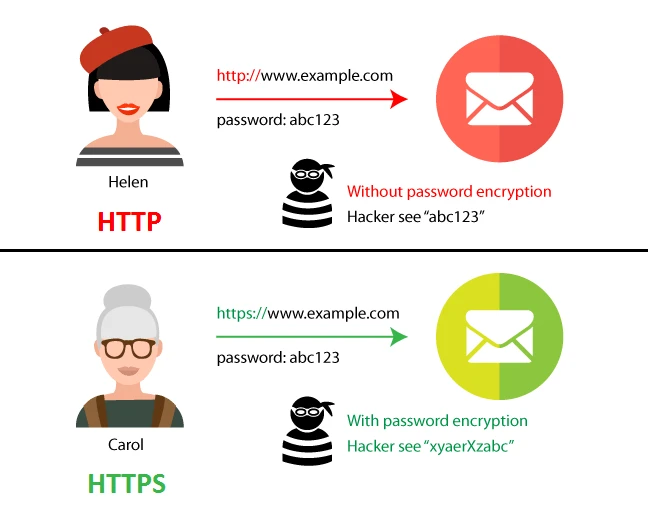
So, what does this mean in practice? The HTTPS protocol adds an extra layer of security to your website by encrypting the data exchanged between users and your site. This way, all sensitive information, such as passwords or payment data, is protected from hackers.
By choosing HTTPS, you ensure the confidentiality and integrity of your users’ data, which also strengthens trust in your website. In addition, search engines give greater importance to secure websites, which can improve your ranking in search results.
So don’t let your site be labeled as not secure! Switch to HTTPS now and make sure your users enjoy a safe and worry-free browsing experience.
The HTTP protocol (Hypertext Transfer Protocol) is a communication protocol used for transferring data on the Web. It allows clients, such as web browsers, to request resources from servers and receive the corresponding responses. The HTTP protocol operates on port 80 and is generally used for non-secure websites.
The main drawback of the HTTP protocol is that it is not secure. This means that the data exchanged between users and the website is not encrypted, making it vulnerable to hacker attacks. When you access a non-secure website using the HTTP protocol, you risk compromising sensitive information such as passwords or payment details.
To ensure the safety of your users and protect their data, it is essential to switch from the HTTP protocol to the HTTPS protocol.
The transition from the protocol HTTP to the protocole HTTPS offers many advantages for you as a website owner, as well as for your users.
First, by switching to the protocol HTTPS, you ensure the confidentiality of your users’ data. All sensitive information, such as passwords, payment details, and personal data, is encrypted and cannot be easily intercepted.
In addition, the protocol HTTPS strengthens user trust in your website. Modern browsers display a green padlock next to the URL to indicate to users that the site is secure. This helps enhance your site’s credibility and reassures users about the security of their data.
Finally, switching to the protocol HTTPS can also have a positive impact on your SEO. Search engines, such as Google, increasingly prioritize secure websites in their rankings. By switching to the protocol HTTPS, you can improve your visibility in search results and attract more organic traffic to your website.
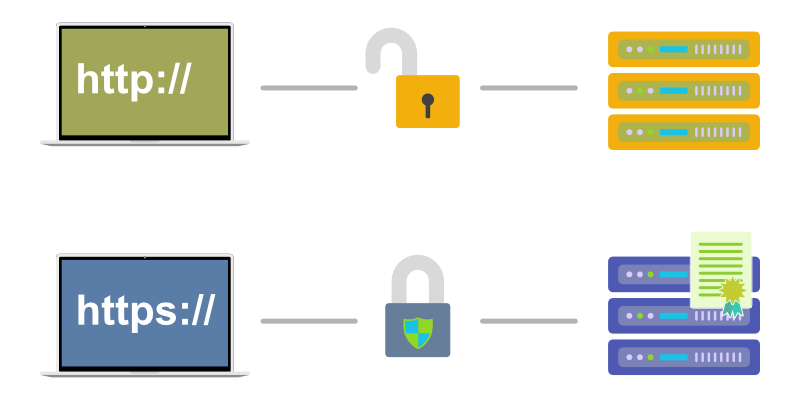
The HTTPS protocol (Hypertext Transfer Protocol Secure) is a secure version of HTTP. It uses SSL/TLS encryption to ensure that the data exchanged between the browser and the server is protected against external attacks. HTTPS operates with an SSL (Secure Sockets Layer) or TLS (Transport Layer Security) certificate, ensuring that the data is encrypted and authenticated.
Switching from the HTTP protocol to the HTTPS protocol offers many advantages for you as a website owner, as well as for your users.
First, by switching to the HTTPS protocol, you ensure the confidentiality of your users’ data. All sensitive information, such as passwords, payment details, and personal data, is encrypted and cannot be easily intercepted.
In addition, the HTTPS protocol strengthens user trust in your website. Modern browsers display a green padlock next to the URL to indicate that the site is secure. This helps enhance your website’s credibility and reassures users about the safety of their data.
Finally, switching to the HTTPS protocol can also have a positive impact on your search engine optimization (SEO). Search engines such as Google increasingly prioritize secure websites in their rankings. By adopting HTTPS, you can improve your visibility in search results and attract more organic traffic to your site.
Switching from the HTTP protocol to the HTTPS protocol may seem complex, but it is actually a relatively simple process. Here are the steps to follow to complete the migration:
During the migration to HTTPS, it is important to take certain precautions to avoid potential issues. Here are some points to consider:
There are many tools and resources available to help you during the migration to HTTPS. Here are some of the most useful ones:
When migrating to HTTPS, it is easy to make mistakes that can negatively impact your site. Here are some common errors to avoid:
Switching from the HTTP protocol to HTTPS is essential to ensure the security of your site and the privacy of your users’ data. By using SSL/TLS encryption, you can provide your users with a 100% secure browsing experience.
In addition to enhancing security, migrating to HTTPS offers many benefits, such as increased user trust, improved SEO, and higher visibility in search results.
Be sure to take the necessary precautions when migrating to HTTPS and make use of the available tools and resources to simplify the process. Avoid common mistakes and ensure that everything works correctly after the migration.
By following these steps, you can guarantee your site’s security and provide your users with a safe, worry-free browsing experience. Don’t let your site be labeled as insecure—switch to HTTPS now and ensure your users enjoy completely secure navigation.

MonDesign Web, your digital marketing agency, dedicated to guiding you to the pinnacle of your online success.



We use cookies to improve your experience on our site. By using our site, you consent to cookies.
Websites store cookies to enhance functionality and personalise your experience. You can manage your preferences, but blocking some cookies may impact site performance and services.
Essential cookies enable basic functions and are necessary for the proper function of the website.
These cookies are needed for adding comments on this website.
Statistics cookies collect information anonymously. This information helps us understand how visitors use our website.
Google Analytics is a powerful tool that tracks and analyzes website traffic for informed marketing decisions.
Service URL: policies.google.com
Marketing cookies are used to follow visitors to websites. The intention is to show ads that are relevant and engaging to the individual user.
Facebook Pixel is a web analytics service that tracks and reports website traffic.
Service URL: www.facebook.com
 #!trpst#trp-gettext data-trpgettextoriginal=1947#!trpen#Optimized by #!trpst#trp-gettext data-trpgettextoriginal=1946#!trpen#Seraphinite Accelerator#!trpst#/trp-gettext#!trpen##!trpst#/trp-gettext#!trpen#